Thursday, March 15, 2007

Use It Up (everyday trash in absentia)


NOTE: Since I'm have used up all my blogger techmentality mojo and can't seem to figure out basics of posting via wordpress, I'm temporarily posting items for everydaytrash here. We'll move 'em over when Leila returns.

Apologies to everydaytrash faithful who thought they need not fear trash withdrawal while Leila ventured to other continents. I will spare you any excuses and just get down to it.

So many efforts are made to look to the future to solve our trash-related challenges that I wanted to take a brief look to the past. Before "Reduce/Reuse/Recycle" became a household mantra (if not yet a real habit), there was World War II and a slew of resource conservation propaganda. Back in the day, there were extensive efforts to encourage individuals to cut back or do without in almost every aspect of everyday life - do you really need to go on that trip? Are you preparing your home for winter so that you use the smallest amount of fuel needed? Suburbanites, have you planted a victory garden on your property so that industrial farmers can sell more of their food to support soldiers overseas?

I can't resist asking the obvious rhetorical question about why no similarly widespread federal initiative exists today. For those who don't want to call what's happening in Iraq a war, (or, reasonably, would prefer not to think of Iraqis as the enemy), there's always the real and universal enemy of global warming to rally against.

In any case, for your historical reading pleasure, here's a great short from Straight Dope at the Chicago Reader, reviewing which WWII efforts were beneficial (most) and which were mostly propaganda designed to boost morale (one or two). The Decatur Daily talks to folks who lived with rationing as everyday practice. More pix from wartime poster propaganda like the above (don't you love how innocently racy the Use It Up poster is?) can be found here (fair warning that plenty of these are far from PC). And, back to the present, San Francisco revitalizes the victory garden for 2007.

Sunday, March 11, 2007

Dry and Droll


But you need not be Brit to find the BBC's program (programme) Recorded for Training Purposes funny, all sketch and satire. I love the fake ad for pc fruit products, whose claims include that "We make the Body Shop look like a Japanese whaling vessel."

Then, there's homegrown smart radio humor, too.

Tuesday, March 06, 2007

When Winning Is Losing


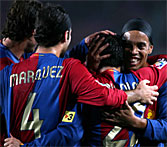
I won't resort to the s-word epithetics of my Man Utd-supporting coterie of friends, but Beatles orginators notwithstanding, Liverpool is not among my favorite locales these days, its futbolers having lost to Barca yet somehow still having managed to knock 'em out of the champions running.

I'm not about to shift allegiances from club or sport, but this whole "you can win the game but lose the championship spot" is probably part of the reason this game still has a bit of a difficult time in the U.S.

Deco, above right, in away colors.

Verdict

One down, four score and 7 (give or take) to go.

Friday, March 02, 2007

What a Mess


I’ll be guest blogging over at everydaytrash while co-conspirator nightgrapefruit is on the other side of the world for a couple of weeks.

If you haven’t found everydaytrash yet, we're not talking parishiltonnicolerichie trash. We mean dirty, smelly, nasty trash, the kind that you probably just drop down the garbage chute or set out on the curb and don’t think about again, even though you should. In Leila's absence I will deliver the second-finest in trashy news and commentary from all corners of the world.

For the moment I'm figuring out how to post on Wordpress, but will be spewing forth soon enough.

Thursday, January 25, 2007

Grits


I found the note below in my e-mail queue this morning:


Dear Kimberly,

Beginning in April 2006, we collected online data from you and over 600 other participants. The study you completed helped us learn more about grit, defined as passion and perseverance for long term goals. Gritty individuals have consistent interests over time and pursue goals even in the face of failure. Individuals who score lower on the grit scale are less persistent and more likely to move frequently from interest to interest. Though individual questionnaire scores will not be reported, these results, obtained from the entire sample, may be of interest to you as a participant.

As expected, gritty individuals were more conscientious. Grit was also associated with an agreeable disposition and extraversion. Grittier people were more satisfied with their lives. Grit was highest among participants aged 65 and older and lowest among participants aged 25-34. Ratings of grit by self-report closely matched those of friends and family members. That is, our conception of our own level of grit seems largely aligned with the conceptions of our intimates.

Unfortunately, we are not able to answer individual queries about this study at this time. However, we do appreciate your participation-thank you!

Angela Lee Duckworth, PhD
Positive Psychology Center
3701 Market St. Suite 209
Philadelphia, PA 19104

215/898-1339 (office)
215/573-2188 (fax)
duckwort@psych.upenn.edu (email)
http://www.sas.upenn.edu/~duckwort/


***

I have a vague recollection of reading some pop-psych article on happiness a while ago, online, and clicking through to some survey. I'm slightly disappointed that the researchers won't provide my own personal score on their scale of grittiness. But mostly I'm curious about a couple of things. If grit was highest among older participants, isn't that likely because older folks have had more time to be persistent over time, or have learned that it takes time to achieve long term goals, or that people in general grow more concerned with what they make of their lives as they grow older and therefore may work harder as they age to guarantee acheivement? And nothing in the summary about correlations of gender with grit?

Stay tuned. I may just work up enough grit to look into these and other grit-related questions.

Wednesday, January 24, 2007

Public Libraries: Good for Brains, Good for Business

That’s what a new study by the Urban Institute says.


I needed no convincing, but I can always use an excuse to post a pix of my favorite public library: Seattle’s Central Library, here.


From the Philanthropy News Digest summary:

“The study relates specific ways local governments, agencies, and libraries are working together to benefit individuals, agencies, and the community at large in four areas: early literacy services, employment and career resources, small business resources and programs, and a physical presence that contributes to stability, safety, and quality of life, while attracting foot traffic, providing long-term tenancy, and complementing neighboring retail and cultural destinations. Capitalizing on these strengths, libraries can fuel not only current but also emerging economic activity.”

Tuesday, January 23, 2007

Chronicles of Coups


Ryszard Kapuscinski, Polish chronicler of coups and revolutions, has died.

The BBC photo makes him look like a toiler, which I don't doubt - he wrote about dozens of upheavals. But I much prefer the photo in the facing page of my Vintage International paperback copy of Shah of Shahs. It makes him look like the Prince of Darkness, a mischievous and malevolent glint to his eye, an effect heightened by his big arched eyebrows, and completed by the crooked grin that just bares his teeth. I suspect it might be a more honest photo - someone so exposed to so much violence and turmoil often propelled by evil must take some kind of satisfaction from seeking it out again and again. Or perhaps it was just escaping a death sentence not once, but four times, that gave him a gallows humor. Then again, this one, pulled from the Wikipedia commons, has a touch of the charming, erudite intellectual about it and seems genuine enough.

The only work of his I've read is Shah of Shahs, assigned last year for school. I think he underestimated the role that memory of Mossadegh and the 1953 coup played in the consciousness of Iran in 1979 - Kapuscinski dismissed Mossadegh as ineffectual and inconsequential. But he seemed masterful at illuminating the mass psychology of living under two back-to-back interpretations of brutality, first the Shah and his Savak, and then the Ayatollahs and their Komitehs. It's usually so easy to think of behaving as a unfree person impossible from where I sit, but not after reading Kapuscinski. It's time to pick up more of his work.

Thursday, January 18, 2007

Futbol Facts


I e-mailed my first draft of my master's project off on Tuesday, and had enough time in the afternoon to stop in to catch what I thought would be an easy Barca victory over a less accomplished team. After Barca was up 2-0 early on, the boys clearly thought it would be easy, too, and started to play that way. Until they found themselves facing a little guy named Wellington and a 2-2 tie shortly thereafter. What I thought would have been a boring game in an almost-deserted bar turned into quite a thrilling 3-2 win and made up for my having missed too many matches lately. Victory is always sweeter when it's hard-earned.

First half drink: bloody mary
Optional: meat pie
Second half drink: guinness (usually only when needing reinforcement during a close match, like Tuesday's against Alaves)
51% of reason for supporting Barca: mas que un club
49% of reason: There's not a bully or grandstander in the bunch. Plus Ronaldinho has the grace to never forget to say thanks to God for helping him look good. And then, as I have previously observed, Frank Rykaard always looks gorgeous in a suit.
Hero of the day: Saviola
Possibly edging out Gio as my fave: Guily.

May Cooler (and Smarter and More Courageous) Heads Prevail


Days after the U.S. dispatched a second set of battle ships to the Middle East, the BBC reports on efforts underway in Congress to force President Bush to seek its approval should he pursue an attack on Iran. If the resolution did manage to pass both the House and Senate it would hardly guarantee a more clear-eyed policy. Remembering my favorite bogus Power Point presentation a la Colin Powell in early 2003, I would never underestimate the ability of something of far less substance to effect events of great material impact. But I find the possibility of a resolution a little heartening in any case.

Elsewhere, FP's blog notes the obvious potential parallel of current U.S. rumblings in the direction of Iran with the Gulf of Tonkin farce that got the U.S. mired in Vietnam. The only thing I really take issue with in the FP bit is Mike Boyer's suggestion that a Tonkin-esque instigation to justify an attack against Iran seems far-fetched. If the original trumped up Gulf of Tonkin incident and the aforementioned Power Point tell us anything, it's that all those seemingly far-fetched wacko notions are disproportionately effective at starting these sorts of things.

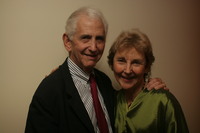
Finally, I was surprised back in October that the American press did not make more noise about Daniel Ellsberg's (pictured with Mrs. E, above) call in Harpers for insider Bush admin wonks to do earlier for Iran what he tried to do for Vietnam by leaking the Pentagon Papers. Ellsberg encouraged wonks like himself to reveal the administration's secret plans (perhaps now less and less secret on a day-by-day basis) to attack Iran. You'd think the Times and the Wa. Post, the financial beneficiaries of Ellsberg's risk (not to mention beneficiaries of that little old Supreme Court case involving prior restraint) would love to get their hands on such documents. It would at least sell papers, if not protect the national interests that might be served by preventing another nasty and immoral war.

P.S. Meanwhile, as the U.S. bemoans Iran’s nuclear ambitions, likely years from fruition, bigger and brawnier China surprises the world by getting its ballistic satellite-destroying missles off in space right now.

Tuesday, December 26, 2006

East - West

Laugh at the clever Aljazeera headline for this story about Wal-Mart in China ("Walmart Hosts Communist Party"), cry at the sad irony that none of the chain's U.S. stores are unionized.

Aljazeera's English-language cable TV channel launched a short time ago, with all the media junkies and critics keeping a close eye. Never mind that they've had an English-language website for a while - one would think in the age of bloggers and ubiquity of the net, that would've garnered more and earlier attention. The website relaunched when the TV channel went live; the colors are less jarring now, but the page is too busy, like too many of its contemporaries; I liked how the old version stuck to basics (including linking to their Code of Ethics on the frontpage, unlike others, which are buried half a dozen clicks into to obscure pages, if they exist at all). One thing that the website is still doing, though, along with the TV channel, is not always starting with the same predictable slew of top international stories that CNN and other competitors run. Aljazeera is covering news as if the world doesn't start and end in the West.

Wednesday, November 29, 2006

The Evangelist

I read last month that there is talk of making Ayn Rand's tome Atlas Shrugged into a film. And I remembered that, despite my bona fide teenage obsession with Rand's work (I'm pretty sure I read it all, and went to Objectivist meetings too boot for a while), I had never seen The Fountainhead on film. Netflix rectified that over the Thanksgiving weekend. I also recently picked up a (mericifully) cheap copy of the book.

I can see why The Fountainhead appealed to my teenage self: all the iconoclasm, all the idealism, all the homage to human creativity and freedom (I managed to overlook the ideological and economic implications of Rand's work at the time). I'm here to report that the film (for which Rand wrote the screenplay) is oh-so-very true to the book, but not for the qualities that attracted me to the story as an adolescent: it's overwrought, histrionic, and lacking all subtley. My adult self cringed and giggled all the way through the film, and cringed and giggled all over again when I opened up the book. It's not that I don't still find aspects of Rand's basic take on what makes people tick useful or accurate to some degree. It's the evangelical hypercapitalism that gets me - along with all the drama.

P.S. Ha - one of the external links on the Rand wiki page takes you to The Atlasphere, a dating and networking site "Connecting the admirers of The Fountainhead and Atlas Shrugged" ! - I'm just not sure why Anthem didn't make the cut?

If you would like to comment on my choice of image, just note this was the only commons image I could find....

Thursday, November 16, 2006

Inventory

I just noticed how long a lapse I've had here. Rest assured I've been thinking about writing, but potential posts are in various stages of edits. Too many things seemed interesting to me in the last month, which is a good thing. But now I have to get around to finishing up my thoughts in some semi-tidy packaging for posting here. Until then, here's a summary of topics of works in progress:

The passage of what would have been the 100th birthday of Hannah Arendt, and what she really meant - not what most of us think she meant - when she coined the phrase The Banality of Evil - and all kinds of heavy stuff about the nature of human freedom.

The announcement that Ayn Rand's Atlas Shrugged will be made into a film ( I've got the old Patricia Neal * Gary Cooper Fountainhead on the way to me via Netflix), and my adolescent foray into the inner sanctums of the Objectivists. Also included: how I somehow squared this with my burgeoning socialistic views.

George Orwell: we all must read his nonfiction, as well as fiction, from a very early age. If his undiluted moral sense didn't permeate our collective consciousness and make the world a far better place, most of the English-speaking parts of the world would at least write much better.

An inventory of a recent visit to San Francisco, including wondering just why cars appear parked in the middle of the street there, ostensibly for church. Double parking in NYC is nothing compared to this. Plus a comparison the Public Libaries of Portland, OR, Seattle, WA, NYC, and SF. And maybe something about how New Yorkers are spoiled by having so many Great Public Spaces.

Polar Bears are shrinking, along with the polar ice caps.

When We Were Kings (the film) and how Muhammad Ali is, unlike most of the people we so easily bestow the title upon, an actual hero, and why. And how I coincidentally ended up watching Street Fight, about Corey Booker's first mayoral campaign in Newark, right after Kings, and therefore must compare one old school black american hero with one new school black american hero-in-the-making.

My cab ride coming home late from work tonight, during which the young Turkish driver showed me it is possible to be both supremely cynical and idealistic at the same time, and with grace.

Wednesday, October 11, 2006

The Useful and the Beautiful - Meet Here


Once more, Art, meet Wonk...Wonk, meet Art.

See?! HERE’s what I mean about The Municipal Art Society (MAS).

MAS, in conjunction with Brooklyn Speaks , has just reminded us about their June call for Forest City Ratner to revamp its plans for the Atlantic Yards Project (16 skyscrapers, 18,000 seat arena), citing 5 design and planning principles:

1. Respect the character of existing nabes (i.e. reduce the density of the project and don’t build megaskyscrapers).
2. Public streets should not be eliminated (keep 5th Ave open)
3. Create a real public park (don’t pretend that strip of green behind the skycrapers is going to be geographically inviting for locals who don’t have access to proposed skyscrapers)
4. Promote lively streets ( by promoting the small businesses that characterized the area, and not overshadowing them with skyscrapers)
5. Deal with the traffic increase that will be created (by actually coming up with a plan for it, including improving public transit).

Check out the featured Brooklyn Speaks slideshow contrasting the current Ratner “vision” with what is and could be. You can also add your name to those who support the Brooklyn Speaks.

I keep the 2003-04 Annual Report for MAS on my desk, because in addition to being the most useful and beautiful (my two principles for anything) annual report/ advocacy tool combination ever, it quotes, over a photo of the lawn at Bryant Park, their founding members from 1893:

“To make us love our city, we must make our city lovely.”

Tuesday, October 03, 2006

Volunteerism

I find it interesting and disturbing that when the BBC asks its readers How to Stop School Shootings (in response to the PA Amish killings), virtually all of the responses focus on gun control.

I agree that the U.S. prediliction for guns is a big piece of the puzzle. But what no one seems to acknowledge is that in so many of these cases, the killers turn the guns on themselves. That suggests to me that these acts are about desperate attention seeking, and like more straightforward forms of suicides, when covered by the press in ad nauseum, this post-mortem attention encourages similar acts.

The public has our Right To Know, but i'm not sure we always need to know about things moments after they happen. My First Amendment Fundamentalist status notwithstanding, I propose press organizations voluntarily (no gov't compulsion involved here) simply stop covering school shootings on a breaking news basis. Don't descend en masse, and don't take satellite feeds. Maybe leave it to the local old-fashioned print media to send a few reporters out. Leave the cameras behind. Then, in a few days or a week, put it on page 2 as a post-event analysis. Or don't cover it at all. It seems plain that all that media doesn't prevent these things from happening, and I really think it may be part of what prompts others to act similarly. There are plenty of violent events that don't get any coverage. Why shouldn't school shootings be the same way?

Sunday, October 01, 2006

The Polar Bear Post


When I first read about this guy who decided to get really close to a captive panda, I thought the guy gave the Panda a gash that required stitches. Thankfully, it was the other way around. And, the facility (not a zoo, but more like a breeding facility) says it won't punish the perp (i.e., the guy, not the bear).

This interests me because in my long-delayed post about the 1987 polar bear attack on a 12-year old who'd taken a swim in the bear's moat in Brooklyn's Prospect Zoo, the bear was most definitely punished with a swift death by responding emergency services officers (the Gothamist panda bit links to the Times Select articles about that event). The kid *was* killed, mind you, but he was also messing around after dark in a zoo full of wild animals that was off limits, and entered the bear's moat on a dare, suggesting that the 3 kids involved knew they were flirting with danger. Don't think that I'm some animals-should-have-the-same-rights-as-humans type, or that I'm not sympathetic to a terrible result of the oh-so-typical behavior of a 12- year old kid.

But polar bears are easily the largest, most aggressive, most defensive, strongest, toughest mofos among mammalian carnivores. Barry Lopez's chapter on the bear in his book Artic Dreams is highly recommended. It's practically a love letter - a deep appreciation for what is an astounding being. Auugh. He describes the bear from behavior to physiology, including the amazing and efficient hairs that keep in warm in its chilly home, and the reprehensible record of man's interaction with the bear. It's an homage that helps you understand why the Inuit traditionally respect and fear the bear in equal measure, without ever having to visit up north. (Lopez' book is fascinating even if you aren't interested in the Artic).

Most of us don't get drunk or dared and climb into zoo enclosures to, for whatever reason, be nearer the animals. But I still have to wonder what zoos actually teach us about wild animals, and especially what they teach us about our place in relation to them. I grew up with the zoo and wild animal parks in San Diego as my main form of weekend entertainment; my mother has Super-8 footage of me gleefully cavorting with the goats in the petting zoo as a toddler. I had a stuffed raccoon until I was 8 or 9. I got as close as the chainlink fence and 6 inch glasses permitted me to see the tigers (always my favorite) at the wild animal park. I have a natural fear and awe of things that are bigger than I, and owed at least in part to the zoo, an appreciation. But I wonder how much that natural fear - and therefore, appreciation - is diminished when, after watching Gus (pictured here) at Central Park Zoo mellow and swimming, an 8 or 10 or 12 year walks into the gift shop at the zoo to see a dozen cutified and stuffed versions of Gus there for the purchase.

Friday, September 29, 2006

The Impoverished Competition


I've been very good about not pouting that no one else here appreciates the star power of Shahrukh Khan.

But I did notice the other day that around the corner from SRK's billboard sits another billboard with another famous bollywood face for another shi-shi brand of watch - and it's the son of Amitabh, Abhishek Bachchan, pictured here.

I must say, though he might have daddy's classic good looks, as for charisma....he doesn't come close to Khan, and the face on that billboard may as well be of any reasonably handsome mortal walking the streets below. I can't imagine what the ad folks who thought he could vie with SRK had in mind. Sorry, Abhishek. You're no match for Shahrukh.

Monday, September 25, 2006

Art Meets Wonk


The Architectural League is one of those many places in my adopted hometown that so consistently and constantly produces fascinating projects that I’m often overwhelmed by its opportunities. Of all the Don’t Miss exhibitions, competitions, panels, and projects they are always offering, Architecture and Justice: Criminal Justice as Urban Exostructure is Definitely Don’t Miss.


This particular exhibition and program look at mapping incarceration and return rates in different American cities, and the policy implications of those patterns.

But it also reminds me of other policy implications in the relationship between architecture and incarceration. My work sometimes takes me to a small town upstate; the big shiny new high school is built on a site originally meant for a prison. When the town's NIMBY elements managed to block the prision, to save money the municipal authorities used the same blueprints for the prison to build the school, changing key features but also keeping the cellblock system in place. The shape of a building - at least in theory - says everything about its function, and the message to the kids who attend is obvious. That’s some policy implication.

And-
The Architectural League is housed in a gorgeous building at 457 Madison Avenue that is The Urban Center with another of my favorite NYC art-meets-wonk agencies, the Municipal Art Society, which champions urban design and planning and “believes that the physical city -- its light, air, land and open spaces -- and its sensible development are critical to New York's continued economic health and social well-being.” Check it out.

Thursday, September 14, 2006

More Rx for Dubya: More Deep Breaths

I am shocked! Simply shocked, I tell you, to learn that
the U.S. may have distorted its report on Iran's nuclear program
.

I shouldn't make light....but....eh. At least they didn't send poor Colin Powell out with a Power Point as Exhibit A this time round.

No response yet from DC.....

UPDATE: I'm a bad blogger and posted after reading the BBC report but not reading the U.S. report or the IAEA's reply. Let me start over.....

I am shocked, simply shocked, to learn that the U.S. DID distort its report on Iran's nuclear program. Here's the IAEA reply to the U.S. Report. Read it - it's short, and quite informative.

Wednesday, September 13, 2006

Do-Gooders


The cynic in me says, "Eh, right, next comes the corporate logo!" But the cule in me says, "I'm so down with Barca's new UNICEF logo!".


Plus, discovery: it's not the action photos that make coach Frank a hottie. It's the suits!